
'It is for the first time the voices of the most deferred, the most neglected, the most ignored, the most abused, the most vulnerable - the children-- has been heard. It is a great moment.' 'I always wanted Pakistan and India to have good relationships because I believe that this is very important for the development of both the countries.' 'If children are taught hatred, if they are taught about sectarianism and prejudice, then we can see that there will be terrorism in society." Nobel Peace Prize winners Kailash Satyarthi and Pakistan's Malala Yousafzai were given an ovation after they delivered their rousing speeches in front of a packed audience at a glittering ceremony in Oslo on Wednesday. A day later, they sit down for an interview with CNN's Christiane Amanpour and share their dreams, their hopes for the future. Read excerpts from the interview.

'The Opposition has no option but to make it an 'All versus One' fight to even think about winning.'

There are conflicting signs on India's investment cycle.
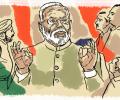
Kamal Nath argued that Modi had 'overexposed himself': By constantly pushing his own image on social media and on TV, attaching his name to multiple promises, Modi had become the face rivals could easily blame for India's chronic dysfunction.

It's a packed 5-nation, 9-day, visit for Prime Minister Modi as he heads to Uzbekistan, Kazakhstan, Kyrgyzstan, Turkmenistan and Tajikistan, apart from Ufa in Russia.

'Building on the potential for closer ties is the changing narrative in each country about the other. The Chinese narrative on India has become significantly more positive over the past few years,' says Walter Andersen and Zhong Zhenming.

Thailand's embattled Prime Minister Yingluck Shinawatra on Monday rejected opposition's two-day ultimatum to quit, saying she is willing to do "anything" to end spiralling violence but cannot accept the unconstitutional demand to hand over power to an unelected council.

Leading think tank discusses a likely Narendra Modi government and America's engagement with the man US once scorned. Aziz Haniffa reports

Policy of continuity won't help India earn business or respect, says Pramod Kumar Buravalli.

The Sindhis are a lesson in perseverance. Once uprooted, they've started all over, often reinventing themselves

'Competence, experience, matter, did you say?' 'No music was sweeter than the mash of xenophobia, jingoism, racism, misogyny.' 'And the master busker to play the tune was round the corner to capture an eager audience just in the nick of time.' Shreekant Sambrani on the Trump Triumph a week after his upset victory.

The fact that everyone but Agriculture Minister Radha Mohan Singh is speaking on the issue only gives credence to the specious fears of farmers that this government is out to get them. Aditi Phadnis reports

Anti-nuclear activist S P Udayakumar, who has been called a threat to the economic security of India by the Intelligence Bureau, speaks to A Ganesh Nadar.

'The main ploy of the BJP's pre-poll proclamations on corruption was so cacophonous and resounding that it unexpectedly worked out to its greatest advantage. But there seems to be a lull after the sound and fury over corruption,' says Ram Ugrah.
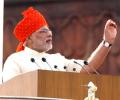
Aditya Puri thinks the government is on track.

Place your bets only on cities where you can easily monitor and where there's visible growth.

The US is still a place for innovation and entrepreneurship, and it is good to see Indian Americans and immigrants contributing to this in a major way, says K V Seshasayee who visited the US after four years and found the gloom had dissipated.

Hindu-American Congresswon Tulsi Gabbard coasts to a rollicking re-election victory in in Hawaii's 2nd District

IIM-B, professor R Vaidyanathan talks to Shobha Warrier about black money, Mudra Bank and Jaitley's Budget.

If the chemistry between Modi and Xi Jinping goes well, it will herald a new future not just for the region but for the world, says Tarun Vijay.

'Unity in diversity is a dated notion as India, today, is more unified and cohesive and yet more pronouncedly diverse than ever in its history,' argues Shekhar Gupta.

'Everybody says 5G and communication is important.' 'Everybody says automation, robotics, human computing interfaces -- people and machines working together -- is the future.' 'Everybody agrees that cybersecurity is something that is here to stay.' 'Everybody agrees that synthetic biology is important.' 'Instead of outlining thinking about industries for tomorrow and the future, let the evolutionary pathway be built in a way that it promotes robust, creative, thinking.'

All mankind looks for good news on a daily basis. It is only a natural human desire. Corporate managements, government spokespersons, political loyalists, merchants and salespersons, all work overtime to create good news. And governments, too, keep trying this with inane pronouncements all the time, says Raj Liberhan.
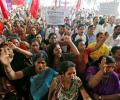
'SBI is already too big. Too big to fail.' 'It already is a moral hazard. What will it do with 20,000 branches that it cannot do with 14,000, especially in these days of online and mobile banking?'
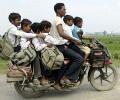
It is time for Mr Modi to be a little more reasonable and rational.
The truth is that few ministries in the Modi sarkar are working on new and updated legislation of any kind.

Pranjul Bhandari, Chief India Economist, HSBC, speaks about a range of issues ranging from inflation, to how Goods and Services Tax and land acquisition bills can help India hit double digit growth, and her impressions about economic growth in the last one year after Narendra Modi took over as India's Prime Minister.

Two years into power, there is very little to show for the Modi government by way of 'achievements' on the foreign policy front, and his China, Pakistan policies are gasping for breath, says Ambassador M K Bhadrakumar.

'15, 17 years back we were not even in existence in the US. Today nearly 1/3 of prescriptions written comes from India.' 'India is showing that in a very competitive environment -- like the US and Europe -- our industry is doing very well.'
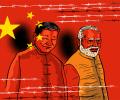
'As China rises and India grows to reclaim their earlier positions on the world stage as two of the largest economies and most important countries, there will indeed be some contention between these two powers.' 'There will also be plenty of space and room for cooperation amongst the two of us.' 'As our economic size increases to match the fact that we are the two most populous nations on earth, it will be all the more important for us to keep the interests of our peoples as well as those of the rest of the world in mind.' 'We shall have to grow together rather than as separate and disparate entities,' points out Ambassador Gautam Bambawale -- who served as India's ambassador to China -- in the 7th annual lecture of the Indian Association of Foreign Affairs Correspondents on March 1, 2019.

After many false starts, India may well be at the inflexion point that Deng Xiaoping took China to post-1978. The window of opportunity is wide open right now, says Rajeev Srinivasan.

'While military acts such as the Uri surgical strikes are one option, cultural, economic and diplomatic isolation should also be part of the arsenal,' argues Sankrant Sanu.

Prime Minister Narendra Modi, who recently completed one year in office, has, in an exclusive interview with Smita Prakash, editor, ANI, said the opposition alleging that his government is a "suit boot ki sarkar" is definitely better and more acceptable than being labelled a "suitcase" (ki sarkar), and satirically added, that after ruling for sixty years, the Congress has suddenly remembered the poor.

'It would not be incorrect to say that the Chinese-Pakistani strategy of containing India began in the aftermath of the 1965 war.'

'The World Cup is being played in the football crazy country after 64 years and nothing excites the Brazilians more than the sacred game,' says B S Prakash, India's former ambassador to Brazil.

The 'secularists'are more adept at the politics of intense and alarmingly exaggerated fear-mongering, as this kind of politics provides easy votes of Muslims without making them answerable for the concrete issues of poverty, unemployment, lawlessness, and of basic needs like roads, electricity, etc, which is exactly how Nitish Kumar was defeated in the elections, says Mohammad Sajjad.

Transcript of the Ganesh Natarajan chat on rediff on Friday.

'It is vital that objects such as the Harihara -- and collections from South Asia generally -- remain here,' the British Museum tells Vaihayasi Pande Daniel.

'India is no longer the India of the '70s and the '80s.' 'It's a large country with the fastest growing economy.' 'In working with India, you just can't go and humiliate the nation publicly.' USIBC President Mukesh Aghi tells Aziz Haniffa/Rediff.com about how he advises American companies to do business with India, what he thinks of Modi's government and the way forward for the India-US relationship.
.jpg)
Candidates in the current state elections must be made to offer specific promises against which their performance can be measured, says Indira Rajaraman
